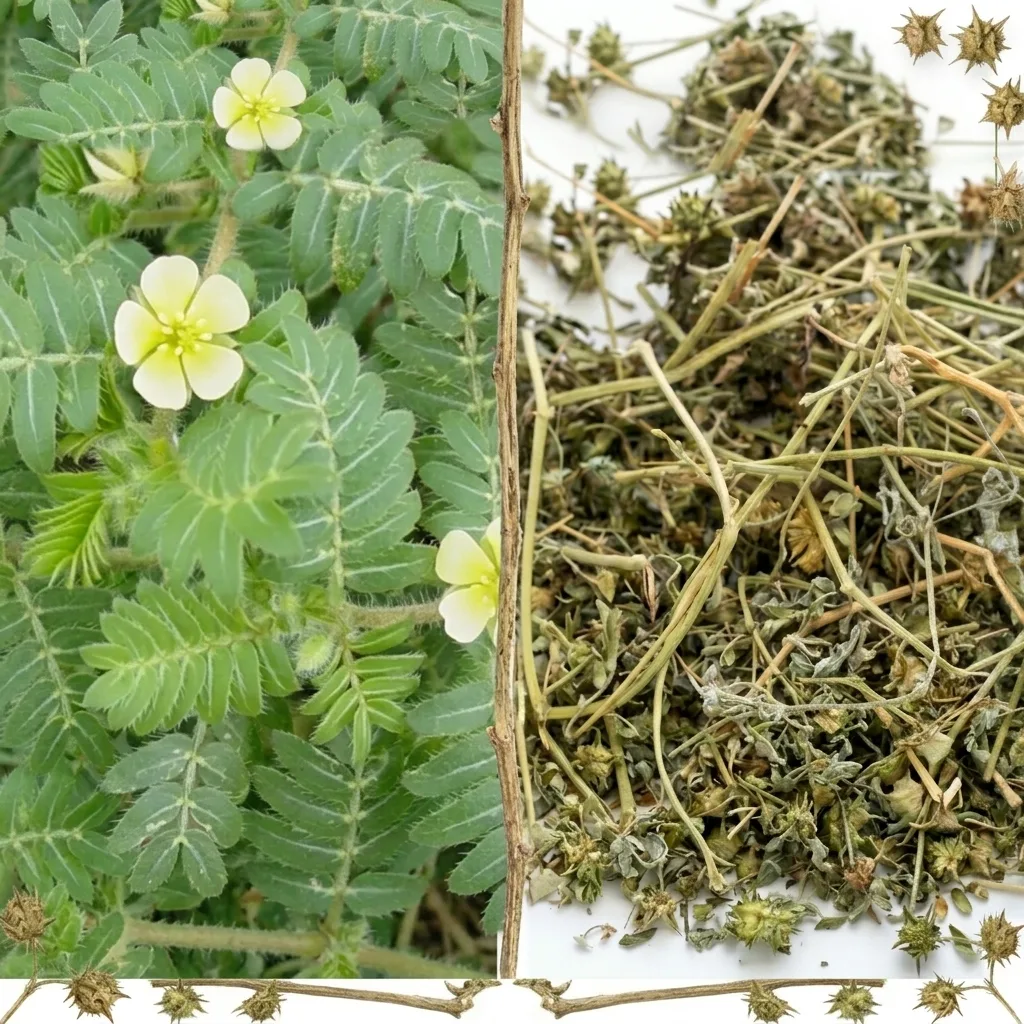
Bulgarian Tribulus terrestris: Quality, Origin and Applications
For manufacturers of dry botanical extracts, dietary supplements and herbal formulations, Tribulus terrestris is a well-established botanical raw material. Yet the same botanical name does not necessarily mean the same chemical profile.
This is where Bulgarian Tribulus terrestris stands out.
More Than a Botanical Name
Tribulus terrestris is widely distributed across Europe, Asia and other warm regions, and occurs naturally in Bulgaria. Its most extensively studied constituents include steroidal saponins, particularly furostanol saponins such as protodioscin and prototribestin.
Research shows that the levels of these compounds can vary considerably depending on geographical origin, plant population, plant part and stage of development.
For a professional buyer, the relevant question is therefore not simply, “Is it Tribulus terrestris?” but “What is the chemical profile of the raw material?”
What Does Bulgarian Research Show?
Research teams from the Bulgarian Academy of Sciences (BAS) have studied Bulgarian Tribulus terrestris populations for many years, documenting substantial variation in their phytochemical profiles.
A study covering 19 populations from the Thracian Floristic Region found marked differences in the levels of the major steroidal saponins. In the richest populations, protodioscin reached 12.79–22.39 mg/g, while prototribestin reached 7.29–21.70 mg/g.
A separate study of 16 populations from Northern Bulgaria also reported a broad range, with 5.0–22.1 mg/g of protodioscin and 3.1–12.1 mg/g of prototribestin.
These findings do not mean that every Bulgarian batch has the same composition or the same concentration of active constituents. Their significance is more practical: Bulgarian Tribulus terrestris can show a distinct and highly variable phytochemical profile, making the characterization of each raw material particularly important.
Origin Matters
International comparative studies have identified clear differences among Tribulus terrestris populations from Bulgaria, Greece, Serbia, Turkey, Georgia, Iran, India and Vietnam. Bulgarian samples have shown a characteristic Southeastern European saponin profile.
Research has also identified sulfated furostanol saponins, including prototribestin, in Bulgarian Tribulus terrestris material.
Geographical origin is therefore one relevant factor when selecting botanical raw materials. It is not the only one. The final chemical profile is also influenced by harvest timing, plant part, growing conditions and post-harvest processing.
Quality Starts Before Extraction
For Tribulus terrestris, this has very practical implications.
When was the plant harvested?
How quickly was drying initiated?
Under what conditions was the material dried and stored?
Research on Bulgarian material indicates that saponin levels change during plant development and that the timing of harvest can have a significant influence on the final profile.
The quality of an extract begins long before the extraction stage. It begins with the raw material and how it is handled after harvest.
Appropriate drying, storage and process control are essential to preserving the raw material's characteristic phytochemical profile. These steps may not be visible in the final product specification, but they can have a direct impact on extract quality and consistency.
From Bulgaria to North America
Tribulus terrestris has a strong international market presence, including in the United States and Canada.
A particularly interesting Canadian example is Bulgarian Tribulus-Extra, a licensed natural health product containing Tribulus terrestris extract. It provides a concrete example of Bulgarian-origin Tribulus making its way into a finished product for the international market.
Why Does This Matter to B2B Buyers?
For manufacturers of dry extracts, dietary supplements and herbal formulations, the quality of Tribulus terrestris depends on far more than its botanical name.
Origin, botanical identification, plant part, processing methods, traceability, and the chemical profile of the raw material all play an important role, as discussed in one of the key topics covered in our previous article.
This is precisely why Bulgarian Tribulus terrestris is of interest as a professional botanical raw material.
At Vesselino LTD., our understanding of the plant starts before the raw material enters the extraction process.
With Tribulus terrestris, a high-quality extract starts with high-quality raw material.